








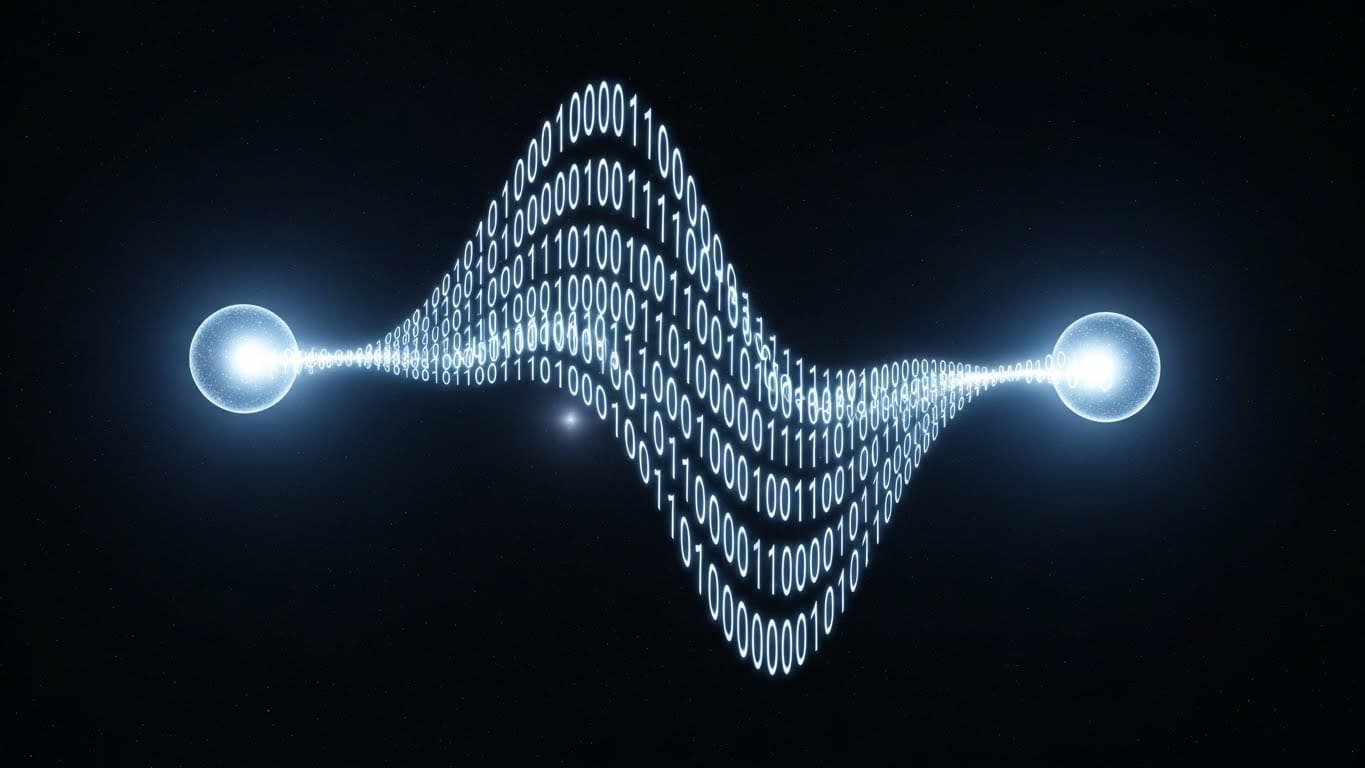

Quantum teleportation is often portrayed in popular media as a futuristic technology capable of transporting people or objects instantaneously across vast distances. However, in reality, quantum teleportation operates under very different principles, and its capabilities are far more specialized and nuanced. So, can quantum teleportation ever transcend its current limitations and transmit more than mere bits of information? To understand this, we need to delve into the foundational concepts of quantum mechanics, explore how quantum teleportation works today, and consider the future possibilities for this extraordinary phenomenon.
Understanding Quantum Teleportation
Quantum teleportation is a process by which quantum information (typically the state of a quantum bit, or qubit) is transferred from one location to another, without moving the physical particles themselves. This is achieved through a phenomenon called quantum entanglement—a deep connection between particles that allows them to influence each other instantly, no matter the distance between them.
The core idea of quantum teleportation is the transfer of quantum states between distant locations via entangled particles. It’s a method of communication that relies on the no-signaling theorem, which assures that information cannot be transmitted faster than the speed of light. This might sound paradoxical, but it allows for quantum information to be transferred without any actual physical transmission of matter.
In its current form, quantum teleportation involves three essential steps:
- Entangling particles: Two particles are prepared in an entangled state, meaning their properties are linked in such a way that measuring one instantly reveals information about the other.
- Sending classical information: The sender (Alice) performs a measurement on their particle, which destroys the quantum state of the original particle but also generates classical information about its state. This information is sent via classical communication channels to the receiver (Bob).
- Reconstruction of the quantum state: Using the classical information, Bob can then perform a specific operation on their entangled particle, which reconstructs the original quantum state of Alice’s particle.
While this process transfers the quantum state accurately, it doesn’t move the physical particle itself. Instead, it allows the quantum information (or state) to “appear” at the distant location.
The Limitation of Bits: Current Capabilities

At its core, quantum teleportation today is about transmitting information at the quantum level. The “bits” being transmitted are not traditional binary bits (0s and 1s) but quantum bits, or qubits. These qubits have the unique property of being able to exist in a superposition of states, which allows quantum computers to perform certain types of calculations exponentially faster than classical computers.
The limitation of quantum teleportation, however, lies in the fact that it currently only transmits quantum states—that is, information about how a particle behaves. The bit in this case is a representation of quantum information. This is far from the physical transportation of objects or even larger data forms such as complex molecules or human consciousness, as imagined in science fiction.
To put it another way: while you can teleport the quantum state of an electron, you can’t teleport the electron itself or a complex structure like a computer. The quantum teleportation process works best for small-scale information—single qubits or small quantum states.
Could Quantum Teleportation Transmit More Than Just Bits?
While quantum teleportation is currently restricted to transmitting quantum states of information, it’s important to consider what the future may hold. The theoretical framework of quantum mechanics suggests that quantum teleportation could, in principle, be extended to transmit more complex states of matter—though significant challenges remain.
1. Teletransporting Complex States (Beyond Single Qubits)
The simplest case of quantum teleportation involves a single qubit, but could this process be extended to more complex systems, such as large collections of qubits or even macroscopic objects? In theory, quantum teleportation could be scaled up to transmit larger quantum states by entangling larger systems of particles and teleporting those states. This could allow for the transmission of more complex quantum information, potentially enabling the transfer of a fully quantum computer state across distances.
However, this raises numerous technical and practical challenges. One of the significant barriers is the decoherence problem: as systems grow larger, maintaining entanglement and preventing the quantum state from “leaking” into the environment becomes exponentially more difficult. Quantum entanglement is highly fragile, and larger systems are more prone to decoherence, which could cause the quantum teleportation process to fail.
2. Transmitting Physical Matter
The idea of teleporting not just quantum information, but physical matter—say, a human being or an object—is a tantalizing concept often explored in science fiction. However, this would require the ability to map and transfer the exact quantum states of every particle in the object, which is an unimaginable task.
To teleport a human being, for example, every atom and subatomic particle within the body would need to be precisely scanned, and the quantum information for each particle would need to be transmitted to a distant location and reconstructed there. Not only is this technically impossible with today’s technology, but it also raises serious philosophical and ethical questions. Could the person who is “teleported” still be the same person after the process? What happens to the original body? These questions are often explored in thought experiments around teleportation paradoxes.

Moreover, even if quantum teleportation could someday transmit physical matter, energy would be required to manipulate and reconstruct the matter at the destination, which brings us back to the limitations of current technology and understanding.
The Future of Quantum Teleportation: Possibilities and Limitations
While it is unlikely that quantum teleportation will ever allow for the teleportation of physical objects or people, there are still exciting possibilities in the realm of quantum communication and quantum computing.
1. Quantum Internet and Communication
One of the most promising applications of quantum teleportation is the development of a quantum internet. By utilizing quantum entanglement and teleportation, it may be possible to create ultra-secure communication channels that are immune to eavesdropping. The security of quantum communication comes from the no-cloning theorem, which states that quantum information cannot be copied exactly. This would make any attempt to intercept a quantum transmission detectable, providing an unbreakable encryption method.
This quantum internet could transmit not only qubits but also allow for the secure transfer of highly sensitive data over long distances. By combining quantum teleportation with classical communication, it could lead to advancements in secure data transmission for both private and governmental uses.
2. Quantum Computing Networks
As quantum computing progresses, the ability to teleport quantum information between distant quantum computers could enable distributed quantum computing. In a distributed quantum computing system, individual quantum computers could share qubits and combine their processing power. This could accelerate the performance of quantum algorithms, especially for complex tasks such as simulating molecular interactions or optimizing supply chains.
3. Quantum Sensors and Imaging
Quantum teleportation might also play a role in enhancing quantum sensors and imaging technologies. For instance, quantum teleportation could potentially be used to teleport quantum states of sensors across different parts of a network, enhancing the precision and range of quantum measurements. This could have applications in medical imaging, environmental monitoring, and navigation systems.
Conclusion
In the current landscape, quantum teleportation remains limited to transmitting quantum states of information—what we typically think of as “bits” in the quantum realm. However, the future holds exciting possibilities as quantum teleportation technology advances. While we may never teleport physical matter as we see in science fiction, we could see more complex systems of quantum information being transmitted across great distances, paving the way for innovations in communication, computing, and even sensing technologies.
As we push the boundaries of quantum mechanics, it is essential to keep in mind that the true potential of quantum teleportation might lie not in moving objects but in revolutionizing the way we handle information. Through this process, quantum teleportation could ultimately redefine the very nature of how we communicate and compute in the quantum era.