










Space — once the exclusive domain of governments and superpowers — is fast evolving into a new economic frontier. As the cost of access drops and innovation accelerates, one question that tantalizes engineers, economists, and futurists alike is deceptively simple: Is space manufacturing cheaper than Earth‑based manufacturing? The answer isn’t binary. It’s a nuanced economic, technological, and strategic landscape that forces us to rethink how and where we make things. In this exploration, we’ll unpack the economics, the physics, the real costs, the potential returns, and what the future might hold for manufacturing off‑Earth versus on‑Earth.
The New Industrial Frontier
The idea of manufacturing in space has shifted from science fiction to an emerging reality. Companies and national agencies are experimenting with producing advanced materials, pharmaceuticals, and even biological tissues in orbit. By 2029, the global space manufacturing market— encompassing materials, platforms, and finished products — is expected to grow substantially, potentially reaching billions of dollars in value as microgravity environments yield new capabilities.
This isn’t just an R&D exercise. Analysts project that space manufacturing could become a cornerstone of the broader space economy — a sector valued in the trillions as space transportation, satellite data, and orbital services expand.
Understanding the Core Cost Drivers
To compare space and Earth manufacturing, we need to break down the major cost components:
1. Launch Costs — The Elephant in the Room
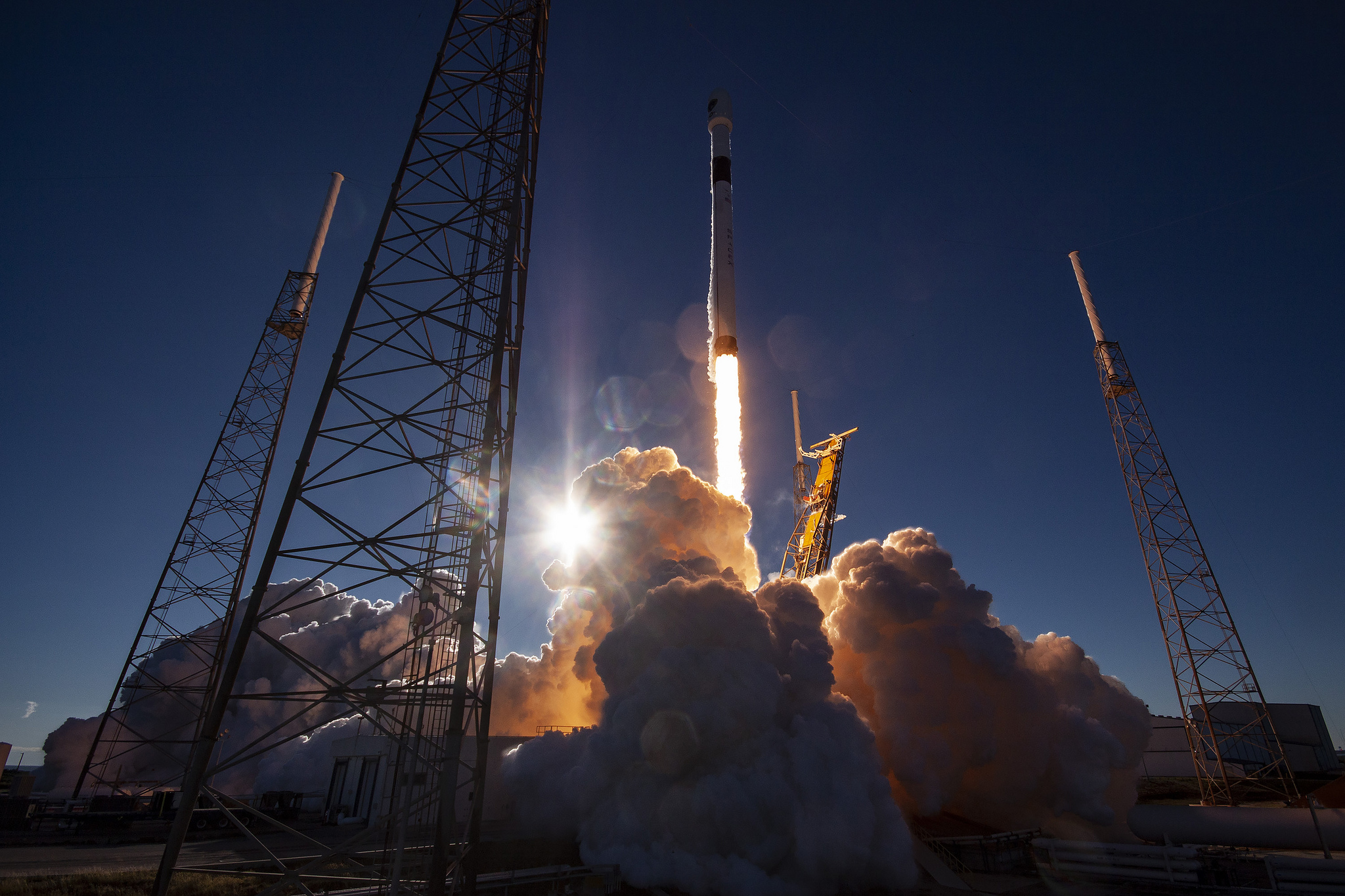
One of the most significant barriers has always been the price of getting mass into space. Historically, this could cost tens of thousands of dollars per kilogram. Today, thanks to reusable launch vehicles such as SpaceX’s Falcon 9 and the upcoming Starship, prices have plunged dramatically — from above $50,000/kg in the Space Shuttle era to potentially below $200/kg in the near future.
This isn’t a trivial drop — it’s game‑changing. But even at lower levels, launch costs remain a dominant part of any space manufacturing calculation.
2. Infrastructure and Setup
Unlike Earth’s manufacturing facilities — where infrastructure can be amortized over decades — space factories require specialized hardware that must be launched, assembled, and maintained in orbit or on celestial bodies. Initial investments can run into billions of dollars before any production begins.
3. Operational Costs and Autonomy
Operating a manufacturing facility in orbit means dealing with harsh environmental conditions: radiation, vacuum, extreme temperature swings, and limited options for on‑site repair. These factors often demand sophisticated robotics and artificial intelligence, which add complexity and cost compared to terrestrial factories.
4. Transportation of Inputs and Outputs
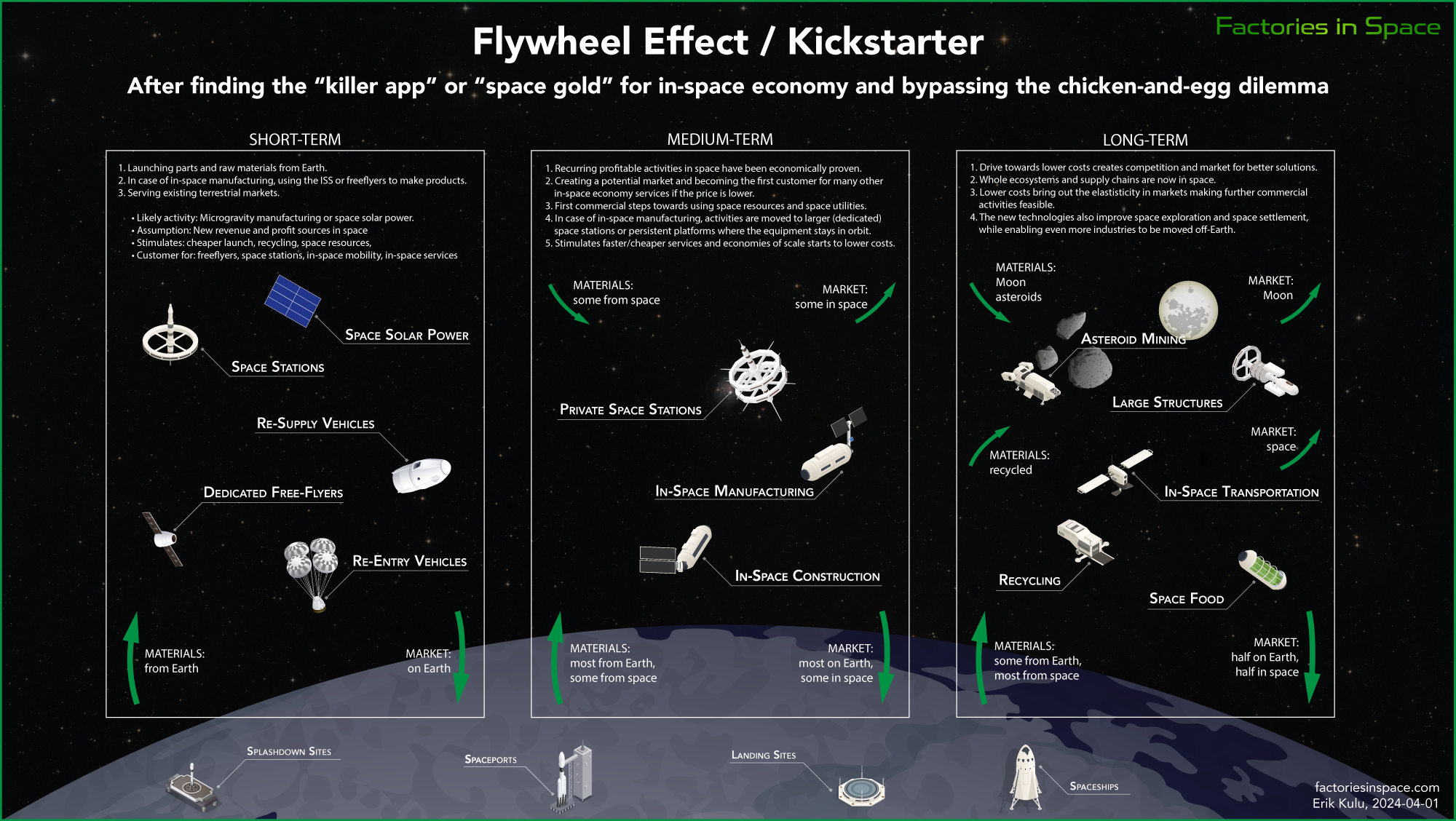
Even if production happens in space, raw materials must be sourced, launched, or mined. Transporting materials from Earth costs money; transporting finished goods may also require return missions or additional logistics, adding to total lifecycle expenses. This is where concepts like in situ resource utilization — harvesting materials from asteroids or moons — become economically compelling, though still unproven at scale.
Where Space Wins: Unique Value Propositions
If space manufacturing were only more expensive than Earth alternatives, it would remain a niche endeavor. But there are compelling reasons to invest beyond Earth’s gravity well.
Microgravity Magnetism
Microgravity isn’t just weightlessness — it’s a fundamentally different environment for fabric formation. Certain crystals, advanced alloys, and biological tissues form with fewer defects and enhanced performance when gravity doesn’t distort their growth. For example, optical fibers manufactured in microgravity can have significantly lower signal loss because they are free from the gravitational sedimentation issues that plague Earth‑based processes.
Pharmaceuticals and Biomedical Innovation
In orbit, protein crystals form more uniformly, potentially accelerating drug discovery. Similarly, 3D bioprinting of tissues and organs takes advantage of microgravity to build structures that would collapse under their own weight on Earth. These breakthroughs—once fully commercialized—could reshape industries from medicine to materials science.
Solar Power and Energy Physics
Space offers nearly uninterrupted solar energy that is more intense than on Earth’s surface. Concepts like space‑based solar power envisage satellites collecting solar energy and beaming it down to Earth, potentially at competitive costs in the long term. While still speculative, early research suggests that this could be part of future energy economics.
Earth Manufacturing: Still the Baseline
While space holds promise, Earth still dominates manufacturing for most products. Why?
Established Infrastructure
Factories on Earth benefit from existing supply chains, energy grids, skilled labor markets, and decades of process optimization. Startup costs are lower because much of the necessary infrastructure already exists.
Materials and Logistics
Raw materials are easier and cheaper to procure on Earth. Transporting heavy inputs is inexpensive compared to boosting them into orbit. Plus, Earth‑based logistics and distribution networks make getting products to market far simpler and cheaper.
Workforce Density
Access to a dense pool of engineers, operators, and technicians means Earth can innovate faster with lower training costs than a remote space factory needing autonomous systems to replace human labor.
The Real Comparison: Cost vs Value
So, is space manufacturing cheaper? Not in most cases today. But that framing misses the full picture.
Functional Value vs Monetary Cost
In many early space manufacturing cases, the value produced — from nearly perfect crystals to breakthrough biologics — may justify the higher upfront cost. A product that performs substantially better than its Earth‑made equivalent can command a premium, effectively creating a new value category rather than competing purely on price.
Learning Curves and Scale
History shows that many technologies start expensive and become affordable as scale and experience grow. The trajectory of semiconductor manufacturing, automotive assembly, and commercial aviation all demonstrate this pattern. Space manufacturing could follow a similar cost decline as infrastructure and processes mature.
Emerging Markets and Adjacent Services
Perhaps the biggest cost advantage of space manufacturing may not be manufacturing at all — but the adjacent economic systems it enables. Satellite data, space transportation services, and orbital logistics could become massive markets that offset or overshadow direct manufacturing costs.
Risks and Uncertainties
Even with promise, space manufacturing faces formidable barriers:
- Regulatory and Legal Complexity: International law around resource ownership and liability in space remains unresolved.
- Technical Reliability: Machines must run autonomously with limited repair options.
- Market Uncertainty: Demand for space‑made products needs to be predictable and scalable.
A Spectrum Rather Than a Binary
Comparing space and Earth manufacturing isn’t a simple less expensive vs more expensive equation. It’s a spectrum where:
- Earth is currently cheaper for most mass‑produced goods.
- Space could be more cost‑effective for high‑value, precision products.
- Space manufacturing may unlock entire new industries whose economics don’t map neatly to Earth‑based analogs.
Viewed this way, space is not a competitor to Earth — it’s a complementary arena where economics evolve alongside technological capabilities.
The Future of Manufacturing Beyond Gravity
If launch costs continue their historical descent and infrastructure in orbit proliferates, then space manufacturing could transition from costly experiment to strategic advantage. By mid‑century, the combination of Earth and space fabrication could resemble today’s global supply chains — interconnected, specialized, and optimized for place‑based value. Early adopters who crack the space manufacturing code may well define the next industrial revolution.