








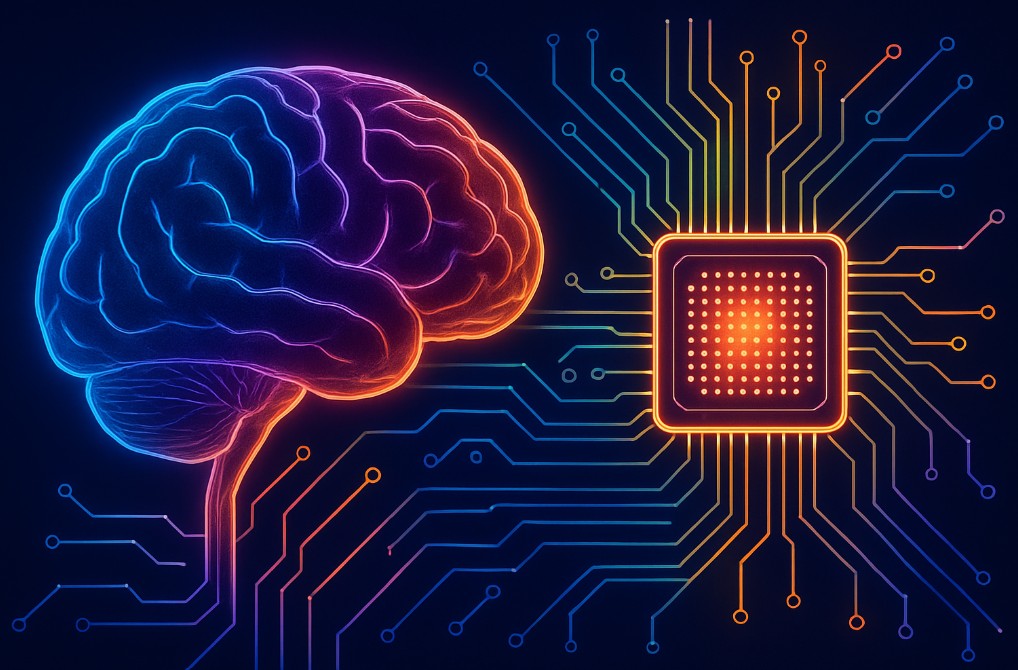

The question isn’t just technical — it’s philosophical. We are essentially asking whether machines designed to think like the brain can outperform machines built around logical, clock-driven engineering that has governed computing for over seven decades. This isn’t science fiction; it’s a real battleground where computer architecture, artificial intelligence, neuroscience, and energy efficiency collide. In this long-form exploration, we’ll break down what neuromorphic chips are, how they differ from traditional CPUs, where they might shine, where they might struggle, and what the future really looks like if neuromorphic architectures mature enough to challenge the established order.
What Are Neuromorphic Chips?
Neuromorphic chips are a class of processors inspired by the structure and function of the human brain. Unlike traditional Central Processing Units (CPUs) that execute instructions sequentially using von Neumann architecture (separate memory and compute units), neuromorphic chips integrate memory and computation in a way that mirrors neural circuits and synapses. These chips use spiking neural networks (SNNs) — systems where neurons “fire” based on incoming events — to process information in an event-driven, massively parallel fashion.
Brain-Inspired Architecture
Neuromorphic processors emulate key features of biological neural networks:
- Spiking neurons and synapses: Computation is driven by spikes — discrete, event-based signals — similar to how neurons communicate in the brain.
- In-memory computing: Memory and processing co-exist, reducing the energy and time cost of data transfer.
- Sparse event-driven processing: Only relevant parts of the network fire at any time, which boosts efficiency for real-world sensory data.
- Massive parallelism: Thousands to millions of tiny neural units operate concurrently.
Contrast this with CPUs, which depend on synchronized clock cycles, hierarchical caches, and sequential steps. CPUs excel at general-purpose logic, floating-point math, operating systems and database transactions — tasks that are predictable, ordered, and normative. Neuromorphic chips are built for adaptive, noisy, real-world sensory processing — tasks analogous to perception rather than arithmetic.
Why Neuromorphic Architecture Is Different
At its heart, the difference is computational philosophy.
Traditional CPUs: Order and Precision
CPUs are deterministic machines rooted in Boolean logic:
- Complex instructions are broken down into micro-operations.
- Data is moved back and forth between memory and computing units (the von Neumann bottleneck).
- Performance scales with clock speed, pipelining, and cache optimization.
CPUs are brilliant for general-purpose computing but are inefficient for tasks dominated by pattern recognition and real-time sensory interpretation — the very workloads modern artificial intelligence increasingly demands.
Neuromorphic Chips: Event-Driven Intelligence
Neuromorphic chips operate in a fundamentally different regime:
- They respond to events — inputs that trigger processing only when something significant happens.
- They compute and store information locally, reducing the energy cost of data transfer.
- They aim to mimic biological efficiency in pattern recognition, sensor fusion, and continuous learning.
As a consequence, they are not drop-in replacements for CPUs. They specialize in a subset of computational problems, particularly where sensory and adaptive intelligence matters most.
Can Neuromorphic Chips Outperform CPUs — Today?
The short answer: Yes — but only in specialized domains.
Real-World Evidence
Studies show that neuromorphic hardware can dramatically outperform traditional CPUs in specific tasks:
- In sensor fusion tasks common in robotics and autonomous vehicles, Intel’s Loihi-2 neuromorphic chips achieved large gains in both speed and energy efficiency compared to conventional CPUs and GPUs.
- Comparative research on keywords spotting — identifying specific phrases in audio — found that neuromorphic hardware could outperform CPUs and GPUs in energy cost per inference while maintaining similar accuracy.
These examples point to an important pattern: neuromorphic chips excel where the computation involves real-time sensory data, sparse event streams, and adaptive pattern recognition.
Energy Efficiency Advantage
One of the most significant promises of neuromorphic chips is energy efficiency. Because they compute only when an event occurs and integrate memory into the processing fabric, they can use far less power than CPUs. Some research suggests neuromorphic designs can reduce energy costs by orders of magnitude in specific AI workloads.
For battery-constrained systems — like edge AI on mobile devices or autonomous sensors — this makes neuromorphic hardware incredibly attractive.
Limitations and Challenges
Despite the promise, neuromorphic chips face significant hurdles before they can be considered outright replacements for traditional CPUs in general computing.
Lack of Standard Benchmarks
There are no widely accepted benchmarks designed specifically for neuromorphic performance evaluation. Traditional CPU benchmarks don’t capture the unique characteristics of event-driven computing, making apples-to-apples comparison hard.
Software Ecosystem Immaturity
Programming models for neuromorphic hardware are still nascent. Traditional software compilers, operating systems and development frameworks are tied to CPU and GPU semantics. Neuromorphic platforms often require specialized knowledge to express spiking neural networks efficiently — a high barrier for mainstream adoption.
Accuracy and Reliability
Analog variability, noise sensitivity, and manufacturing variability can compromise computation accuracy on neuromorphic devices. Unlike deterministic digital CPUs, neuromorphic chips can exhibit nuanced behavior depending on environmental and hardware conditions.
Integration Challenges
Interoperability with existing computing infrastructure — which is almost entirely CPU-centric — adds overhead. Data conversion, communication protocols, and system design complexities can negate some of neuromorphic chips’ raw speed or energy savings.

Where Neuromorphic Chips Really Shine
Even with limitations, there are compelling application domains where neuromorphic chips already offer distinct advantages — and these may grow over time.
Edge AI and IoT
For devices operating on limited power budgets — smart sensors, wearables, autonomous drones — the low-power, event-driven nature of neuromorphic chips is ideal. They can process sensory streams like vision and audio in real time without draining batteries.
Robotics and Autonomous Systems
Robots and autonomous vehicles need to integrate sensor data (lidar, radar, cameras) continuously and make split-second decisions. Neuromorphic chips, with their parallel event-driven processing, offer faster sensor fusion and reaction times.
Brain-Machine Interfaces
Neuromorphic chips are uniquely suited to interpreting neural signals due to their architectural similarity to biological neurons. This could accelerate breakthroughs in prosthetics, neurorehabilitation, and direct brain-computer interaction.
Predictive Maintenance and Industrial Automation
Because neuromorphic chips process data continuously and adaptively, they can excel at identifying patterns in noisy sensor data — ideal for early detection of machine failures, quality control, and adaptive automation.
Will Neuromorphic Chips Replace CPUs?
Not likely — at least not in the foreseeable future.
Traditional CPUs are entrenched. They power operating systems, software stacks, compilers, databases, high-precision scientific computing, distributed systems, cloud infrastructure — and they do so with decades of ecosystem maturity behind them. On the other hand, neuromorphic chips are specialized coprocessors designed for a niche set of tasks that involve perception, adaptation and energy-efficient pattern recognition.
Complementary, Not Replacement
The realistic future involves heterogeneous computing systems, where:
- CPUs perform general-purpose logic and control.
- GPUs accelerate parallel workloads like graphics and deep learning.
- Neuromorphic chips handle real-time sensory processing and adaptive inference.
This is similar to how GPUs have become indispensable to AI training without replacing CPUs entirely.
Long-Term Outlook
In the long term, neuromorphic architectures could play a significant role in:
- Decentralized AI: Autonomous edge devices that learn and adapt in real time.
- Brain-like cognition: Systems capable of more human-like reasoning, continual learning, and low-power inference.
- Augmented intelligence: Tools that augment human performance by integrating sensory interpretation directly on device.
As research continues — particularly in bridging silicon, neuroscience, and artificial intelligence — neuromorphic chips may one day be core components in systems that are currently unimaginable. But that future won’t come from replacing CPUs; it will come from reimagining what computing means. The future of computing, like the brain itself, might be less about linear instructions and more about dynamic, adaptive, context-aware processing.