









Introduction
In the last decade, the concept of uploading human consciousness — digitizing the mind and transferring it into a computational substrate — has leapt from the realms of science fiction into serious scientific and philosophical discourse. Once confined to dystopian movies and futuristic novels, mind uploading or consciousness uploading now sits at the crossroads of neuroscience, computer science, cognitive psychology, philosophy, AI research, and ethics. But let’s be clear: we are not yet on the verge of transferring a living person into the cloud as a digital ghost. What we are witnessing, however, are real technical and theoretical foundations that make this question more than just sci‑fi speculation.
This article explores the scientific, technical, philosophical, and ethical dimensions of consciousness uploading — examining what’s real, what’s theoretical, and what remains speculative. We will also unpack what “consciousness” means in the first place, because without that foundation, any discussion of uploading is built on shifting sand.
1. What Do We Mean by Consciousness?
Consciousness is one of the most deeply debated concepts across science and philosophy. In the context of uploading, the challenge is determining whether consciousness is:
- a by‑product of brain activity that can, in principle, be copied,
- a fundamental property that cannot be reduced to patterns of information,
- or something in between.
Leading scientific theories, such as Integrated Information Theory, aim to quantify consciousness in terms of data integration and complexity. According to this theory, consciousness correlates with the amount of integrated information a system holds — but it does not yet provide a clear path to extracting and reconstructing that information in a machine substrate.
Other theories, like the controversial Orchestrated Objective Reduction (Orch OR), propose quantum processes within neurons as fundamental to consciousness. While intriguing, these ideas are speculative and have not been empirically validated.
The bottom line: before we can even talk about uploading consciousness, we must first understand what consciousness is.
2. Why Mind Uploading Captures Our Imagination
Science fiction has introduced us to mesmerizing visions of life after bodily death:
- Digital immortality,
- Eternal digital avatars,
- Virtual reunions with deceased loved ones.
These narratives appear in numerous fictional works and visual media, where uploaded minds live without the limitations of the human body.
Culturally, these stories resonate because they touch on two deep human yearnings: overcoming mortality and transcending physical limitations.
But fiction’s ability to imagine possibilities does not automatically translate into scientific feasibility.
3. The Technical Landscape: What Tools Are We Developing?
Though full consciousness uploading is not a reality, current technology is laying pieces of the groundwork.
3.1 Brain‑Computer Interfaces
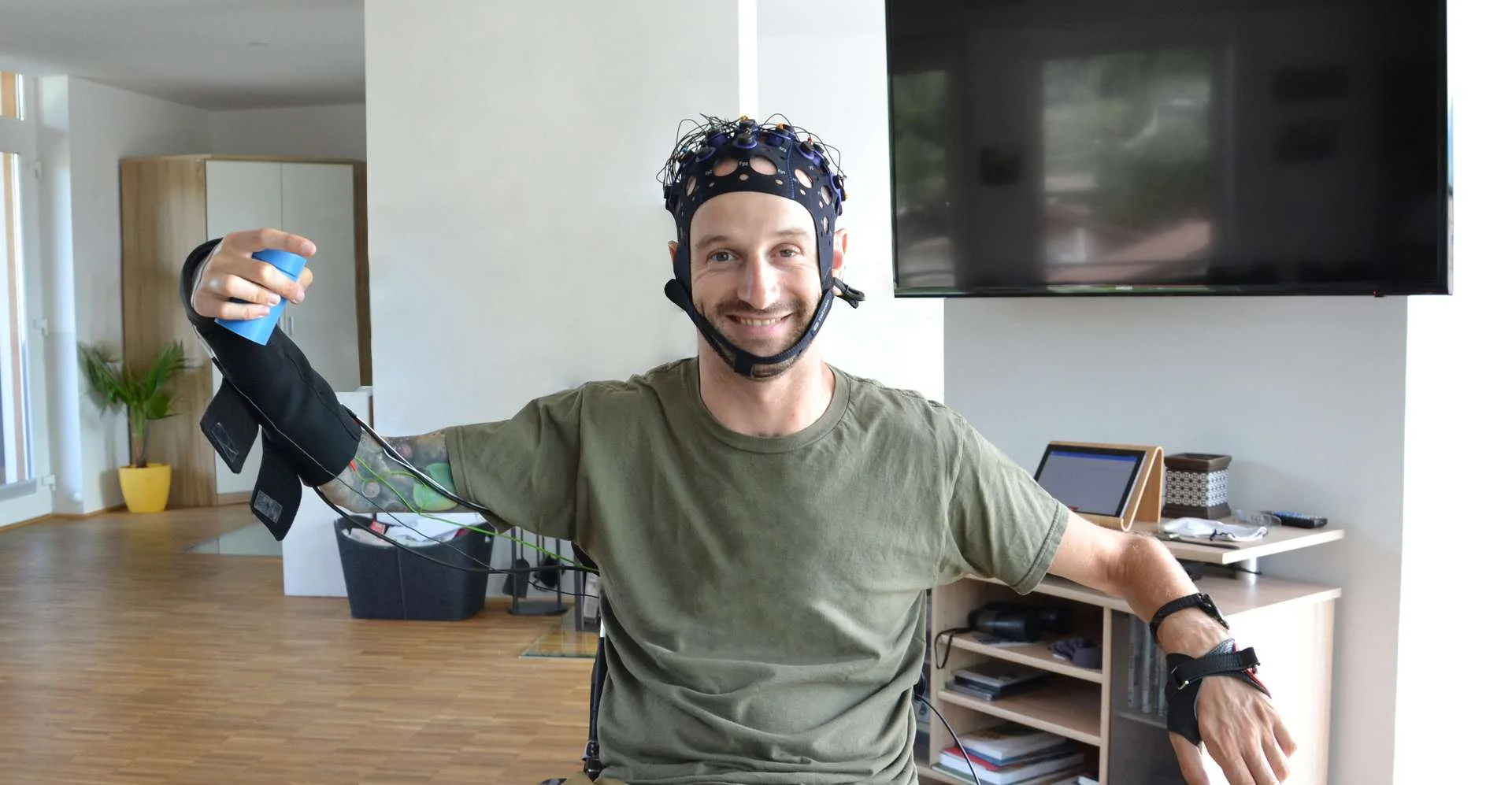
Brain‑Computer Interfaces (BCIs) are real tools being developed to read neural signals and allow direct communication between the brain and external devices. These systems are principally used today to help patients with paralysis control prosthetics or cursors without physical movement.
While reading parts of the brain’s activity is possible at low resolution, completely decoding the full richness of human thought, emotion, memory, and identity remains far beyond current capabilities.
3.2 Whole Brain Simulation
Another technical frontier is connectomics — the mapping of all neural connections in the brain. Hypothetically, if we could map and simulate the complete connectome of a human brain at high fidelity, we might approximate the brain’s computational patterns in a machine.
However, even if we could map every connection and fire up a simulation, scientists debate whether a simulation of the neural network would have consciousness or simply behave in a way that looks like it. In other words, a system could demonstrate sophisticated behavior without experiencing anything. This limits straightforward claims about uploading consciousness.
4. Philosophical and Scientific Barriers
Even if the entire brain could be mapped and computed, this raises deep questions:
4.1 Identity and Continuity
If a scan of a brain is copied into a simulation, is that copy you, or merely a sophisticated replica? Philosophers like Derek Parfit have explored these questions deeply, suggesting that continuity of consciousness is not guaranteed by information copying alone.
Moreover, if the upload process destroys the original brain, is the resulting digital entity a continuation of the same consciousness, or a brand‑new consciousness that merely thinks it is you?
4.2 Hard Problems of Consciousness
The so‑called hard problem — why and how subjective experience arises — remains unresolved. Without solving it, we don’t know whether a digital simulation could ever feel the world, or whether it would merely simulate the feeling.
Some thinkers have even argued that consciousness might be fundamentally non‑computable — meaning that no amount of digital simulation can capture it.

5. Ethical Challenges and Societal Impact
Assuming uploading were possible, its implications would be enormous.
5.1 Social Inequality and Digital Class Divides
One critical concern is whether such technology would create a divide between the digitally immortal and the biologically mortal — potentially leading to a class of post‑human elites and a population of embodied humans.
5.2 Rights and Personhood
Would uploaded consciousnesses have legal rights? Would data copies have personhood, or would they be treated as software artifacts? These questions are not merely hypothetical; they reflect a future legal and social architecture that needs foresight today.
5.3 Privacy and Security
If neural data could be extracted or uploaded, it could potentially be hacked, manipulated, or exploited — raising concerns about autonomy and mental privacy.
6. Practical Research vs Sci‑Fi Hype
At this stage, the practical science of understanding the brain and neural activity is advancing rapidly. But most serious researchers are cautious:
- There’s no agreed scientific definition of consciousness robust enough to support uploading.
- Current proposals stop well short of anything resembling the science fiction trope of immortality.
- Many argue that what we could upload is a model or pattern, not the original consciousness itself.
In 2026, researchers have even started trying to quantify different forms of consciousness in AI systems — not to upload human minds, but to objectively assess whether any artificial system has consciousness-like attributes at all.
7. So, Is Consciousness Uploading More Than Sci‑Fi?
Not yet. At present, the idea remains largely theoretical and speculative. However, elements of the broader vision — such as brain‑machine communication, digital simulation of neural networks, and computational modeling of cognitive processes — are real scientific endeavors with practical applications.
Thus, consciousness uploading is more than pure science fiction in the sense that serious researchers are discussing, modeling, and challenging its assumptions. But we are far from a world in which a biological human can digitally “continue” as a conscious entity after death.
What’s more realistic is that as neuroscience, computation, and cognitive science advance together, we will learn more about the structure of thought, memory, and identity — and that alone would reshape how we understand ourselves, whether or not actual uploading ever becomes possible.