








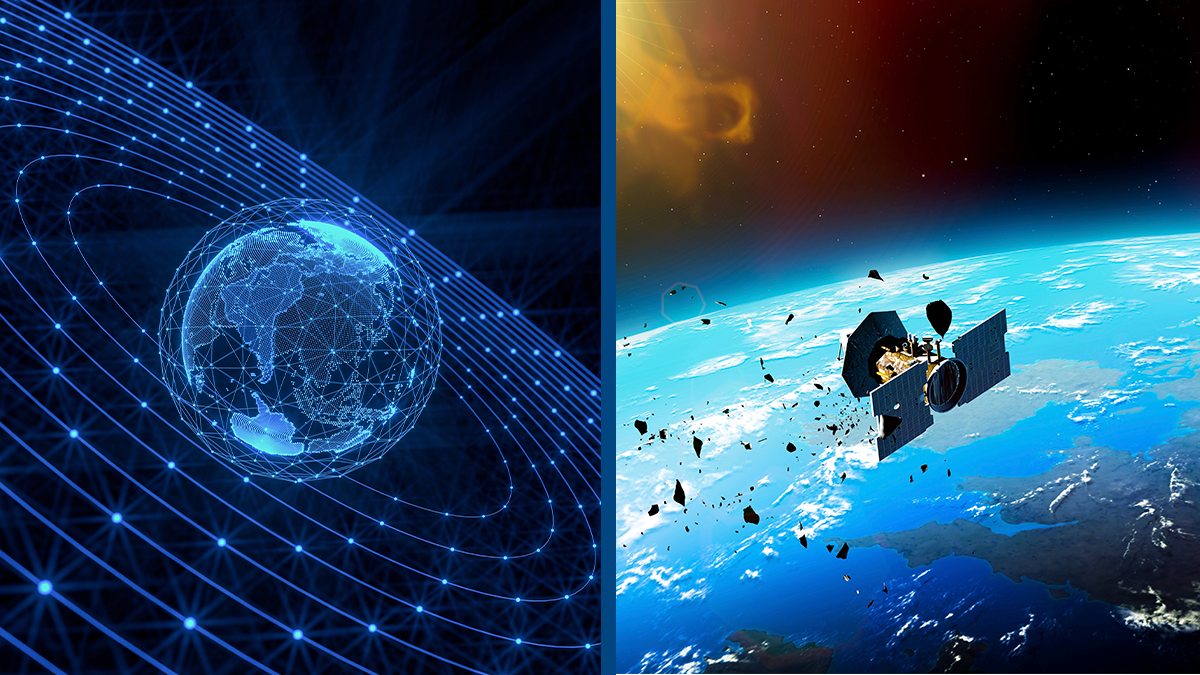

Space may look serene from the ground, but in low Earth orbit (LEO) it’s more like a high‑speed scrapyard. Thousands of satellites, rocket stages, and fragments of human‑made junk travel at staggering velocities—around 28,000 km/h. At these speeds, even a paint‑chip‑sized shard can punch a hole in a spacecraft. Worse, collisions don’t just damage; they multiply the mess, creating clouds of smaller debris that can strike other satellites, and so on. This chain reaction lays the groundwork for what scientists call the Kessler syndrome—a cascading disaster that could fundamentally reshape humanity’s access to space.
In this article, we’ll unpack why space debris collisions are more than an engineering nuisance: they’re a potential systemic hazard with global technological and economic consequences. Through expert analyses, recent data, and a deep dive into the physics and engineering of orbital environments, we’ll explore how a chain reaction in orbit could unfold, what amplifies it, and what the space community is doing (and not doing) to prevent it.
The Invisible Graveyard Above Earth
When rockets deliver satellites into orbit, they often leave behind spent boosters, covers, and other hardware. Over decades, these remnants accumulate. Defunct satellites drift uncontrolled. Tiny fragments from explosions or collisions proliferate. According to tracking by space agencies, tens of thousands of objects larger than 10 cm orbit Earth, and hundreds of thousands (if not millions) of smaller pieces are estimated to be present.
Why does this matter? Relative speeds in orbit are enormous. Unlike cars on a highway, orbital debris travels at tens of thousands of kilometers per hour. Two objects on intersecting paths can collide with kinetic energy greater than a high‑speed car crash. Such an impact shatters the objects, spraying fragments across nearby orbits. These fragments, in turn, become new hazards capable of triggering further collisions.
This cascading production of debris is the essence of the Kessler syndrome. Originally proposed in 1978 by NASA scientists Donald J. Kessler and Burton Cour‑Palais, the concept describes a tipping point where debris growth outpaces the natural decay of objects spiraling back into the atmosphere, setting off a runaway chain of collisions.
Collision Cascades: From Single Smash to Orbital Chaos
Let’s conceptualize how a debris cascade could unfold.
- Initial collision
Imagine two defunct satellites inadvertently cross orbital paths. They collide at hypersonic speeds—enough to fragment both into hundreds or thousands of pieces. - Fragment dispersal
These pieces spread into a local cloud, some on similar orbits, others with slightly different inclinations and velocities. - Secondary impacts
Other satellites or debris that encounter this cloud are struck, producing even more fragments. - Exponential growth
With each collision spawning more fragments, the density of hazardous objects multiplies. What was a single collision becomes an avalanche of debris creation.

This isn’t theoretical animation—it’s grounded in asteroid impact physics and satellite tracking data. The sheer number of objects in orbit means that once a certain critical density is reached, collisions become almost inevitable.
Recent studies underline the real possibility of such cascading events. One model known as the CRASH Clock simulates how quickly the first orbital collision could occur in worst‑case scenarios—suggesting it could happen within a few days if satellites lost the ability to maneuver due to a solar storm or other systemic failure.
Why Chain Reactions Are Worse Than They Sound
Amplification through Exponential Growth
The most insidious feature of debris cascades is exponential growth. One collision becomes two; two becomes four; four becomes eight—very quickly overwhelming orbit with fragments. This is not a linear problem that can be solved by removing a few objects; it’s a feedback loop. The more objects there are, the more likely they are to collide, and each collision creates more potential collisions.
Imagine fireworks in slow motion: one explosion triggers another, and within moments a spectacular but destructive chain reaction lights up the sky. In orbit, it’s not light we see—it’s danger multiplying.
Why Tiny Debris Packs a Big Punch
You might think small fragments are harmless, but at orbital speeds, size matters less than energy. Even a fragment as small as a millimeter can carry enough kinetic energy to seriously damage a satellite’s delicate electronics or solar panels. Over time, these impacts degrade spacecraft reliability, requiring more maneuvers and fuel to avoid hazards—fuel that eventually runs out.
Systemic Risks Beyond the Debris Itself
A debris cascade doesn’t just threaten satellites; it threatens systems on Earth that depend on those satellites.
Impact on Critical Infrastructure
- Communications: Satellites carry data for phone networks, internet services, and broadcasting.
- Navigation: GPS and other global navigation satellite systems rely on intact orbits.
- Climate Monitoring: Earth‑observation satellites feed crucial data about weather and climate.
- Financial Systems: Timing signals from satellites underpin global financial infrastructure.
If debris collisions were to take out a significant portion of the satellite network, these services could fail or degrade, affecting billions of people and disrupting economies.
Events Bringing the Risk into Focus
While a full Kessler cascade has not yet happened, recent real world incidents show how close we might be to dangerous territory:

- Satellite crack emergency: In 2025, a spacecraft suffered cracks from a debris impact, triggering an emergency launch and highlighting how fragile orbital operations can be.
- Rocket breakup debris field: A rocket stage fragmentation event created a cloud of debris that now threatens over a thousand satellites, illustrating how single events can have wide ripple effects.
These events underscore that space debris is not abstract but a pressing operational challenge.
What Increases the Odds of Cascading Collisions?
Satellite Megaconstellations
The rapid growth of megaconstellations like those used for global internet services multiplies the number of objects in orbit, increasing collision probability. One study found that in 2025 there were over 11,700 active satellites in LEO—a huge increase over past decades.
Space Weather and Operations Failures
Solar storms or software malfunctions could disable collision‑avoidance systems on multiple satellites simultaneously, leaving them unable to maneuver out of harm’s way. In such a scenario, the “CRASH Clock” effect would dramatically shorten the time until the first collision.
Inadequate Debris Removal
Despite proposals for active debris removal—such as nets, harpoons, or ground‑based lasers—the technology and policy frameworks are still insufficiently tested at scale. Without robust removal and mitigation strategies, debris accumulates faster than it can be cleared.
Mitigating Cascade Disasters: Tech and Policy
Preventing a runaway cascade requires both engineering innovation and international cooperation.
Design and Operational Best Practices
Engineers can design satellites to burn up more reliably upon mission completion, reducing future debris. Better collision avoidance algorithms and autonomous maneuvering can also help minimize accidental impacts.
Active Debris Removal
Proposed solutions like ground‑based lasers (“laser brooms”) or space‑based capture systems aim to nudge debris into safer trajectories or de‑orbit them entirely.
Global Governance
Space is a global commons, and debris policies require international coordination. Regulatory frameworks that mandate end‑of‑life plans for satellites and transparent tracking data are essential to reduce aggregated risk.
A Future Without Cascades?
Can a chain disaster be avoided? Experts offer cautious optimism—with a caveat. If mitigation and removal efforts scale quickly, it’s possible to stabilize orbital environments and prevent self‑reinforcing cascades. But failure to act could mean reaching a tipping point where cascading collisions become inevitable, rendering some orbits functionally unusable for decades.
The challenge is not impossible—it’s tractable with foresight, cooperation, and investment. But it demands urgency from both public agencies and private actors as space becomes ever more congested.