






The Great Question: Vision, Reality, and the Threshold Between
In a world driven by innovation, imagination, and rapid change, we constantly ask ourselves: what makes something real? Is it enough for a vision to feel real, or must it be demonstrably tangible before we call it real? When we compare a prototype—a concrete embodiment of an idea—with a mirage—an illusion that appears real but isn’t—we confront a fundamental tension at the heart of human progress: how do we separate feasible futures from fantasies without substance?
This is not just an intellectual curiosity. For engineers, entrepreneurs, designers, and strategists, this question shapes decisions that influence markets, technologies, and societies. Understanding the boundary between a prototype and a mirage isn’t merely academic—it’s practical. It affects how we allocate resources, manage risk, communicate visions, and ultimately decide what is worth pursuing.
Let’s explore this boundary in depth, examining both the scientific and metaphorical dimensions of prototypes and mirages, and uncovering what truly makes a vision real.
DEFINITION: What Is a Prototype?
A prototype, fundamentally, is a preliminary model built to test a concept or process. It is concrete, structured, and designed to be evaluated. This definition spans disciplines—from engineering and product development to software design, architecture, and beyond—but the core idea remains consistent: the prototype is a bridge between imagination and reality.
Prototypes serve many purposes:
- To validate feasibility of a design.
- To elicit feedback from stakeholders and end‑users.
- To reveal hidden flaws and assumptions.
- To shape the evolution of ideas into deployable solutions.
In design thinking, prototyping is often described as the phase where “the rubber meets the road.” You move from conceptual sketches to something that others can touch, interact with, or test under real conditions. And crucially, prototypes can be iterative—meaning they change as we learn more. No prototype is final; each one brings insight and informs the next.
Types of Prototypes
There’s a spectrum of prototypes, each with a different relationship to “real”:
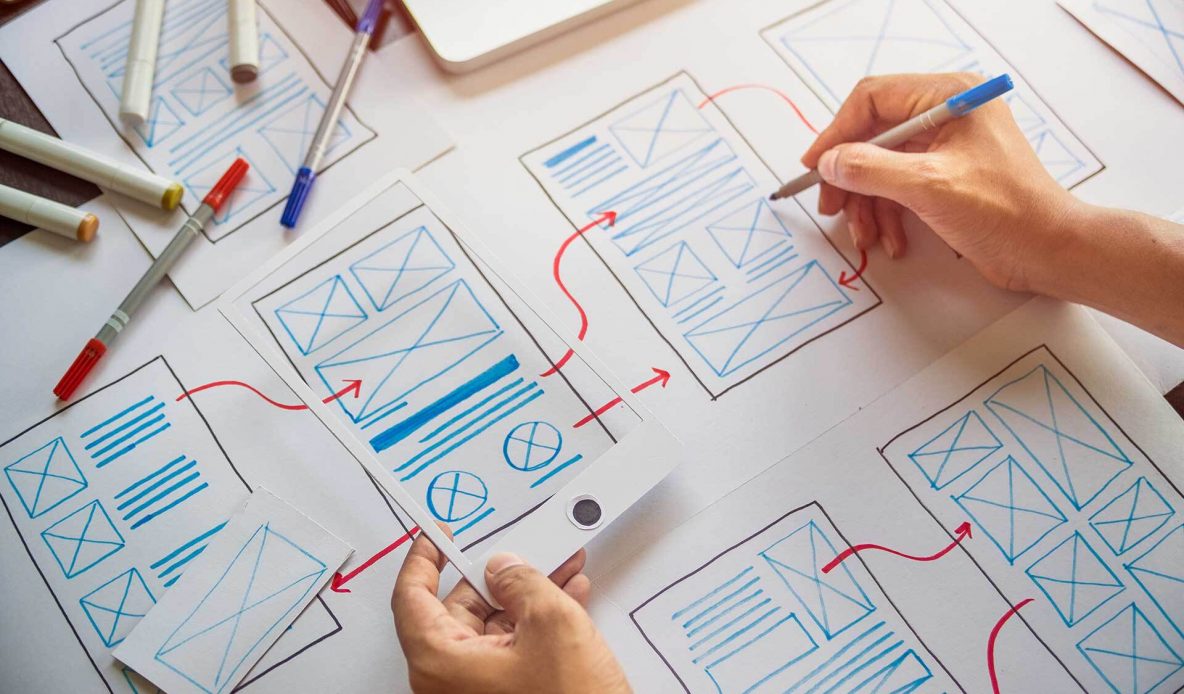
- Low‑Fidelity Prototypes — basic mock‑ups (like sketches or wireframes) that focus on structure rather than function.
- Visual Prototypes — designed to show appearance and layout without deep functionality.
- Functional Prototypes — closer to the final product, with operational features to test real interactions.
- High‑Fidelity Prototypes — almost indistinguishable from the intended finished product, used for immersive user testing.
The purpose evolves as fidelity increases—what starts as a rough sketch becomes a discussion tool, and eventually may act as a proof point that a vision can be executed.
MIRAGE: The Intriguing Illusion
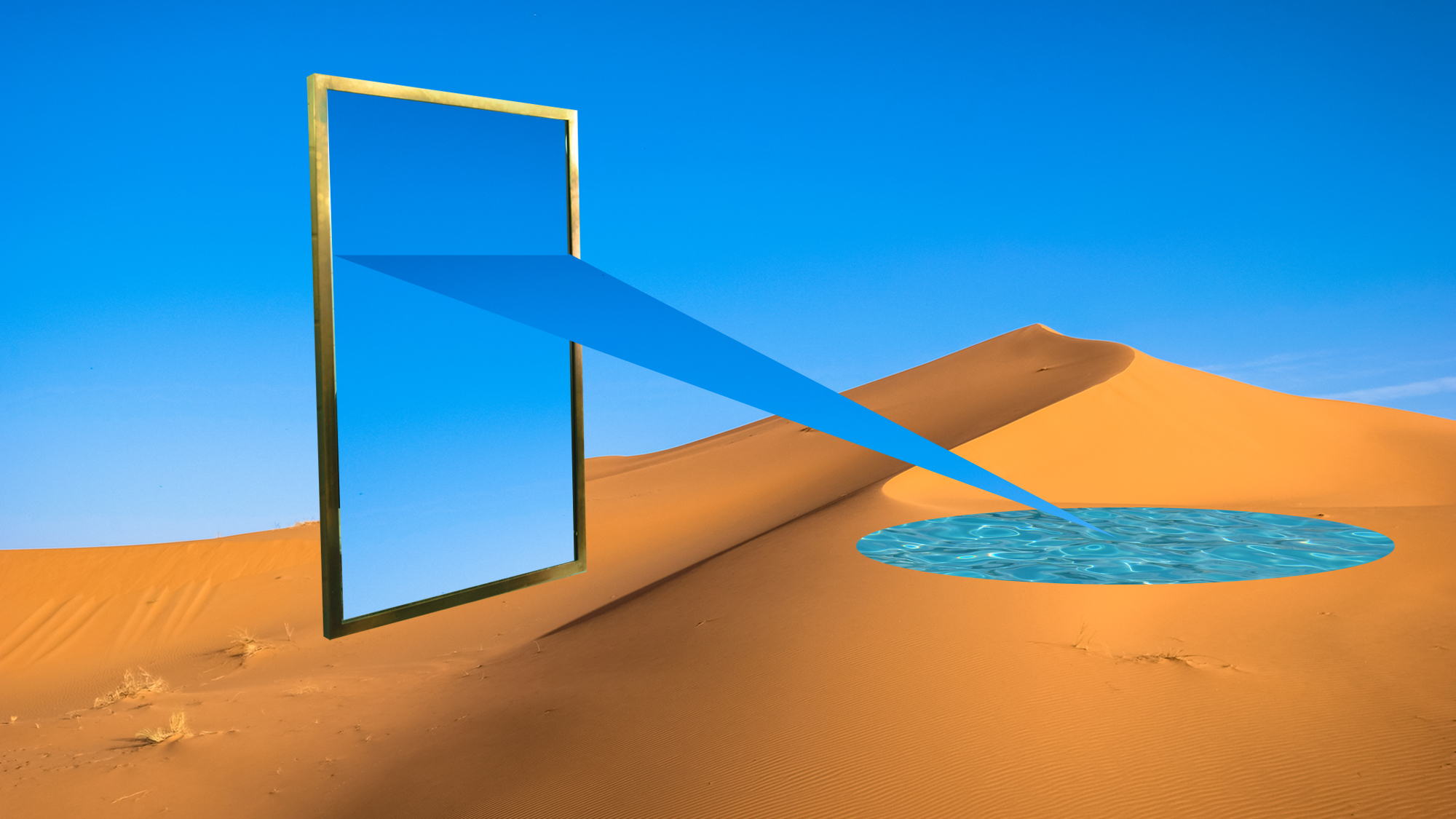
A mirage, in scientific terms, is an optical phenomenon caused by light bending in layers of air to create a displaced image. That’s the classic desert picture: a shimmering pool ahead that vanishes as you approach. It seems real but is not physically present. In language and metaphor, “mirage” has come to mean something that appears real or achievable but ultimately lacks substance or attainability.
It’s worth highlighting that a mirage is not merely a mental illusion—it is caused by actual light refraction and can be photographed. But whether it’s a shimmering highway image or a castle in the clouds dreamed up by the unconscious mind, a mirage remains visually compelling yet unanchored in material reality.
Beyond the Desert
Mirages aren’t just desert phenomena—they appear in polar regions, over oceans, and even in views of astronomical objects when atmospheric refraction causes distorted or multiple images of celestial bodies. In everyday language, the term has expanded: it can describe false hopes, unattainable desires, or aspirations that disappear upon closer inspection.
This makes “mirage” a rich metaphor when applied to visions—ideas about the future that look enticing but lack foundational grounding.
VISION: Where Imagined and Real Converge
“Vision” is an idea about the future, a mental image of what could be. Whether it’s an entrepreneurial pitch, a scientific hypothesis, or a societal dream of equity and sustainability, visions are powerful. They inspire and motivate. But, like mirages, visions can be illusions if they have no viable path to realization.
To understand what makes a vision real, we need to look at both the nature of the vision itself and the process used to materialize it.
The Anatomy of a Vision
A vision typically has several elements:
- Clarity — a well‑defined picture of the future.
- Believability — grounded in logic and known constraints.
- Testability — it should be open to evaluation through experiments or prototypes.
- Value — it should resolve a need or advance a goal.
A vision that lacks these becomes more like a mirage—beautiful in description but untestable, ungrounded, and ultimately unreachable.
This parallels philosophical explorations of reality vs illusion, where reality is defined by causality and empirical verification, while illusion by perception without substance.
PROTOTYPES AS THE ENGINE OF REALITY
Why is a prototype so central to turning visions into reality?
1. Prototypes Force Concreteness
A prototype removes ambiguity. It takes abstract ideas and gives them form, whether physical, digital, or experiential. It allows stakeholders to move from talk to tangible evidence. In user experience design, prototypes let people interact with what would otherwise be only theoretical features.
2. They Validate Core Assumptions
Every vision makes assumptions—about technology, behavior, resources, markets, or environments. Prototypes surface these assumptions. When assumptions fail, prototypes fail early, with much less cost and risk than full implementation.
This is the essence of the “fail fast, learn fast” philosophy in innovation: it’s better to discover limitations before significant investment.
3. They Enable Iteration
Prototyping is not one‑and‑done; it’s cyclical. With each iteration, designers refine their understanding and the prototype evolves. Each cycle brings the vision closer to implementable reality. Without iteration, visions risk remaining static and unanchored, resembling mirages more than prototypes.
4. They Engage Reality Through Feedback
Prototypes invite feedback from users, experts, and environments where the product or idea will operate. This feedback is crucial—it anchors dreams to constraints and optimizes relevance. Visions divorced from feedback risk staying fantasies.
MIRAGES IN INNOVATION: WHEN VISIONS GO WRONG
Why do some visions become mirages?
Unrealistic Assumptions
When a vision relies on implausible technical capabilities, unverified market demand, or unrealistic timelines without supporting evidence, it strays into mirage territory. Without mechanisms to test these assumptions—like prototypes or pilot studies—such visions remain unanchored.
Cognitive Bias and Wishful Thinking
Humans avoid cognitive dissonance by rationalizing hopes as reality. In innovation settings, this can manifest as confirmation bias or overconfidence bias—believing that because we want something to be real, it must be. Without checks, visions shift toward conjecture rather than evidence.
Lack of Incremental Steps
Large visions without intermediate milestones or prototypes collapse under complexity. A detailed roadmap of testable milestones turns a vision from speculation to structured progress.
Misalignment with Stakeholders
Even technically feasible ideas can become mirages if they ignore the needs and behaviors of actual users. A prototype that fails user validation reveals this early; without it, the vision remains a projecting mirage onto others’ expectations.
METAPHORIC MIRAGES VS PHYSICAL PROTOTYPES
The scientific definition of a mirage involves atmospheric physics and refraction of light. Yet metaphorical mirages share an underlying principle: perception without grounding. Paradoxically, a mirage might be more “visually convincing” than a prototype at first glance. A shimmering vision can captivate without delivering substance.
But vision without verification is not reality.
In contrast, a prototype might be crude, rough, even ugly—but it’s real. It exists within constraints, can be tested, scrutinized, and refined. And through iteration, it steps closer to the final product.
Thus, the difference between a prototype and a mirage is not just physical vs. illusory—it is evidence vs. expectation, verifiable performance vs. enticing description.
NAVIGATING FROM VISION TO REALITY
If prototypes are one of the most effective tools to anchor visions, how should creators approach them strategically?
1. Begin with a Clear Hypothesis
Instead of beginning with a general “big idea,” start with specific assumptions to test. What must be true for this vision to work? Each assumption is a boundary that can be tested with a prototype.
2. Choose the Right Fidelity
Early prototypes don’t need to be perfect. Low‑fidelity versions answer early questions quickly. Only after basic assumptions are validated should efforts move toward high‑fidelity models.
3. Center User and Environmental Feedback
A prototype should meet reality, not just expectations. Feedback reveals whether a vision addresses real needs or is merely attracting believers.
4. Iterate, Don’t Defend
Resist the urge to defend an idea at all costs. Iteration lets reality push the design forward, sometimes changing the original vision entirely.
5. Use Prototyping to Educate Stakeholders
Prototypes communicate better than words. They turn abstract visions into shared experience and understanding.
CONCLUSION: MAKING VISIONS REAL
Ultimately, what makes a vision real is not simply the brilliance of its idea, but the rigor with which it has been tested, refined, and validated. Visions are essential—they spark progress. But without mechanisms to connect ideas to the real world, they become mirages, compelling yet insubstantial.
Prototypes are not merely engineering artifacts; they are tools of epistemic grounding—they transform belief into understanding, hope into justification, and potential into evidence.
So when you face a grand vision, ask yourself: Is this a prototype in motion, or a mirage in the desert? The answer will shape whether your idea flourishes or fades.