









Meditation has long been cherished as an ancient path to inner peace, clarity, and spiritual growth. But in the modern era of data, metrics, and self‑optimization, a provocative question has emerged: can meditation be quantified and treated as a biohack? In other words, beyond subjective experience, can meditation be measured, tracked, and enhanced using scientific tools and numeric feedback as part of a systematic performance‑enhancing practice?
The short answer: yes — but with nuance. In this deep, engaging exploration, we’ll unpack what it means to quantify meditation, how modern science measures mindful states, the various metrics used by biohackers and researchers alike, and what limitations and opportunities lie ahead. Along the way, we’ll draw on cutting‑edge research, wearable tech trends, neuroscientific insights, and the evolving culture of self‑quantification.
The Rise of Quantified Self and Meditation as Biohack
The broader quantified self movement — tracking physiological and behavioral data such as sleep, heart rate, glucose, and activity — has transformed how individuals approach personal wellbeing and performance. Biohackers use wearable sensors, apps, and analytical tools to track changes over time and make decisions grounded in hard data.
Meditation, historically a subjective practice defined by inner awareness and attunement, might seem resistant to this kind of reduction. Yet modern science and technology are steadily opening doors to objective measurement of meditative processes.
For instance, meditation as a biohack involves applying measurable metrics to evaluate how effective a particular meditation session, technique, or regimen is, and how it impacts the body and brain. This aligns with the fundamental biohacking ethos: measure, optimize, repeat.
Why Measure Meditation? The Purpose of Quantification
Quantification does not replace meditation; it enhances understanding. It provides practitioners and scientists with insights into the physiological and neural mechanisms underlying meditation, including:
- Changes in brain wave patterns
- Heart rate and autonomic nervous system regulation
- Emotional and stress response modulation
- Cognitive focus and mind‑wandering measures
At its best, meditation quantification turns subjective experience into trackable progress, enabling growth in a systematic way.
Metrics and Tools Used to Quantify Meditation
Quantifying meditation crosses several domains — from neural activity and cardiovascular function to behavioral trends and self‑reports. Below are the most commonly used metrics and tools that make meditation measurable:
1. Brain Waves and EEG (Electroencephalography)
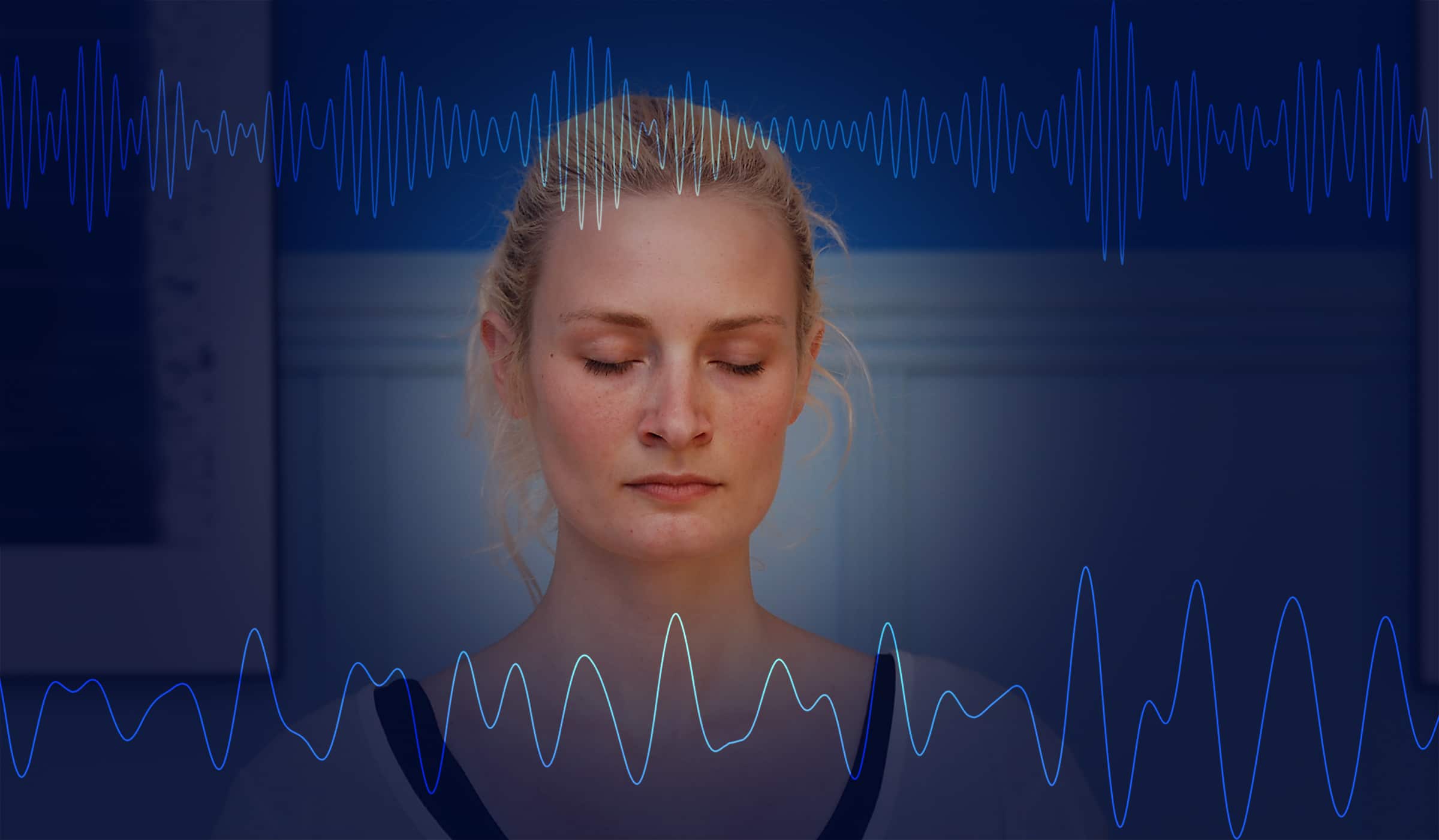
EEG is one of the most direct methods to measure cortical electrical activity. Specific brain wave patterns — especially alpha (8–13 Hz) and theta frequencies — change during meditation.
For example:
- Alpha activity is often associated with relaxed alertness
- Theta rhythms are linked with deep meditative states

Researchers have shown measurable changes in alpha amplitude during mindfulness practices, suggesting meditation modifies attention control mechanisms without necessarily reducing general arousal.
Many quantified meditation systems visualize brainwave data, creating indices such as Attention, Mindfulness, and Silent Mind Index to reflect mental states during practice.
2. Heart Rate Variability (HRV)
Heart rate variability (HRV) — the variation in time between heartbeats — is a powerful marker of autonomic nervous system balance. Higher HRV often corresponds to better stress resilience and parasympathetic activation.
Regular meditators often show:
- Improved HRV over weeks of consistent practice
- Changes in respiratory rate and cardiac rhythms
- Enhanced emotional regulation
Biohackers track HRV using wearables like smart rings, wrist bands, and chest straps to monitor meditation’s effects over time.
3. Resting Heart Rate and Sleep Metrics
Meditation can reduce resting heart rate and enhance sleep quality — two measurable aspects that reflect overall wellbeing. Wearable devices often report changes in:
- Sleep stages: REM, deep sleep, sleep efficiency
- Daytime recovery scores
- Resting heart rate trending lower with meditation practice
These markers provide data that can be compared across weeks or months to assess how meditation influences general physiology.
4. Behavioral and Subjective Scales
While not strictly physiological, subjective tracking (e.g., rating stress, focus, emotional states) offers complementary data to physiological metrics. Tools such as daily mood logs, perceived focus scales, or meditation quality scores give nuance to purely numerical data.
These subjective reports, when paired with objective metrics like HRV or EEG, can paint a richer picture of meditation’s effects.
5. IoT and Wearable Devices
Recent patents and emerging tech suggest integrated systems — combining IoT sensors, AI algorithms, and wearable data — that aim to quantify meditation effectiveness through physiological signals and neural feedback.
Wearables can measure:
- Heart rhythm and HRV
- Skin conductance
- Respiration patterns
- Real‑time brain activity (via EEG headbands)
These tools allow personalized tracking and can even deliver feedback during sessions to guide deeper engagement.
What Biohackers Are Actually Tracking
In quantified self and biohacking communities, meditation is often tracked alongside other metrics to shape lifestyle decisions. These can include:

- Sleep scores and recovery indices
- Heart and respiratory measures
- Mood, stress, and cognitive focus overlays
- Longitudinal trends in meditation duration vs measurable changes
Community practitioners often cross‐compare personal data across weeks and months to refine their meditation practice as a performance variable.
Real‑World Implementations: Events and Competitions
Not confined to labs, meditation quantification has even entered public challenges. For instance, in Tokyo, a “Quantified Meditation Challenge” used advanced neuroimaging and meditation indices to rank participants based on attention and depth metrics — treating meditation achievements similarly to athletic markers.
This illustrates how quantification is expanding meditation from introspective tradition into measurable achievement territory.
Science and Meditation: A Growing But Complex Field
Despite promising strides, it’s important to emphasize that meditation research still grapples with challenges:
- Variability in study designs and meditation types
- Difficulty separating placebo from true physiological effects
- Inconsistencies in measurement standards across studies
Comprehensive analysis, such as that found in foundational works like Altered Traits, shows the complexity and methodological hurdles in meditation research — but also strong evidence that meditation does produce measurable changes in brain and body.
Limitations of Quantification
While metrics provide clarity, they also carry limitations:
- Reductionism: Not all meditative experiences are easily reducible to numbers
- Tech bias: Devices vary in accuracy and often lack standard calibration
- Self‑fulfilling measurement: Focusing too much on numbers can distract from the practice itself
Thus, quantification should be viewed as a support tool, not a replacement for genuine experience.
The Future of Meditation as Biohack
Quantified meditation sits at the intersection of neuroscience, wearable tech, and ancient practice. As technology evolves, we can expect:
- Better real‑time neural feedback systems
- AI‑driven personalized meditation optimization
- Hybrid experiences merging meditation with XR/VR interfaces
- More large‑scale clinical research validating metrics
Rather than diminishing meditation’s mystery, quantification can augment it — empowering individuals to understand and refine their inner world with external precision.
Conclusion: A Nuanced Yes
Can meditation be quantified as a biohack?
Yes — but not in a simplistic way. Meditation can be understood through measurable physiological and neural indicators and integrated into lifestyle biohacks that promote wellbeing, performance, and clarity. These metrics offer powerful insights and feedback loops, but they should enhance, not eclipse, the intrinsic value of mindful practice.
In a world increasingly driven by data, meditation’s journey from intuition to quantifiable biohack reflects a broader evolution: ancient wisdom aligning with cutting‑edge science and technology.